Showing posts with label or. Show all posts
Showing posts with label or. Show all posts
Sunday, March 22, 2015
High Raw or Raw High

People like to label things and raw foodists are no different. Theres a label right there: raw foodist. How do you get to be one of those? Purists would say you must consume only raw, living foods not heated above 118 degrees. Do that, and youre 100% raw. Or perhaps youre high raw, eating primarily a plant-based diet but still consuming some cooked foods. Are you vegan? Vegetarian? Do you eat 80-10-10 or 811rv?
It can make your head spin.
Me? I consume only fresh juice and fruit before noon and eat only raw foods prior to dinner, at which time I may have some cooked food including fish (gasp!), but I always eat my raw foods first. I average between 85-90% raw each day, so I guess that makes me high raw.
But what I really want to talk about is the raw high Ive been experiencing. Dare I say, euphoria?
Listen, if you ever even suggested to me that I might some day feel this way, I would think you were one step away from the loony bin. In fact, a few years back, I had a psychic tell me that she read my Akashic Records and saw that if I ate a diet of primarily fruits, vegetables, nuts and seeds, my body would thrive, find its natural weight and any and all physical ailments would vanish. Live on fruits, vegetables, nuts and seeds? Right. I thought she was wackydoodle and dismissed everything she said to me.
And so, I continued on the road I was on. Burgers, fries and milkshakes were my three food groups. Grumpy, Dopey and Sneezey were my constant companions. I was obese, depressed, constantly exhausted, suffered from chronic edema, allergies, heartburn, and a slew of aches and pains.
Imagine what its like walking around all day, every day, with a 20 pound backpack strapped on, 10 pound ankle weights on each leg, and carrying a 5 pound jug of water in each arm. Hard work. Exhausting.
Now imagine what it feels like when you remove that extra 50 pounds youve been carrying around with you everywhere you go.
FREEDOM. Woo Hoo! Happyhappy, joyjoy.
Thats what I experienced yesterday. It was a picture perfect autumn day. Blue skies and 68 degrees. I set off on a short hike with my Siberian Husky, Maya...
And, heres what I began noticing: I didnt feel winded, short of breath. My heart wasnt racing. My back wasnt aching. My feet werent throbbing. I wasnt sweating like a pig. Hmmmm, thats weird.
So. I kept going...and going...and going...and going...
Ohmygosh, we hiked for over two hours. Up hills, down hills. We even ran. Not a long distance, mind you, but we ran.
Raw high: what you experience after flooding your body with live enzymes and awakening from a food-induced stupor.
Raw high: beats a sugar high, hands down.
Raw high: feeling vibrant and ALIVE.
Raw high: now available at your local farmers market.
It can make your head spin.
Me? I consume only fresh juice and fruit before noon and eat only raw foods prior to dinner, at which time I may have some cooked food including fish (gasp!), but I always eat my raw foods first. I average between 85-90% raw each day, so I guess that makes me high raw.
But what I really want to talk about is the raw high Ive been experiencing. Dare I say, euphoria?
Listen, if you ever even suggested to me that I might some day feel this way, I would think you were one step away from the loony bin. In fact, a few years back, I had a psychic tell me that she read my Akashic Records and saw that if I ate a diet of primarily fruits, vegetables, nuts and seeds, my body would thrive, find its natural weight and any and all physical ailments would vanish. Live on fruits, vegetables, nuts and seeds? Right. I thought she was wackydoodle and dismissed everything she said to me.
And so, I continued on the road I was on. Burgers, fries and milkshakes were my three food groups. Grumpy, Dopey and Sneezey were my constant companions. I was obese, depressed, constantly exhausted, suffered from chronic edema, allergies, heartburn, and a slew of aches and pains.
Imagine what its like walking around all day, every day, with a 20 pound backpack strapped on, 10 pound ankle weights on each leg, and carrying a 5 pound jug of water in each arm. Hard work. Exhausting.
Now imagine what it feels like when you remove that extra 50 pounds youve been carrying around with you everywhere you go.
FREEDOM. Woo Hoo! Happyhappy, joyjoy.
Thats what I experienced yesterday. It was a picture perfect autumn day. Blue skies and 68 degrees. I set off on a short hike with my Siberian Husky, Maya...
And, heres what I began noticing: I didnt feel winded, short of breath. My heart wasnt racing. My back wasnt aching. My feet werent throbbing. I wasnt sweating like a pig. Hmmmm, thats weird.
So. I kept going...and going...and going...and going...
Ohmygosh, we hiked for over two hours. Up hills, down hills. We even ran. Not a long distance, mind you, but we ran.
Raw high: what you experience after flooding your body with live enzymes and awakening from a food-induced stupor.
Raw high: beats a sugar high, hands down.
Raw high: feeling vibrant and ALIVE.
Raw high: now available at your local farmers market.

Monday, March 16, 2015
Medicine Can Treat Why Can’t It Cure or Prevent
Prescription for all diseases: Anti-inflammatory Shock Treatment
Cancer death rates may be finally slowing. Why has it taken so long? Medicine has some cobbled-together treatments for allergies, asthma, Alzheimer’s and atherosclerosis, but all of these are still increasing. Cures and prevention are always ten years away. Something is fundamentally wrong with medicine and the fatal flaw is obvious in the biomedical literature. Causes are not mentioned. Treatments are tested and evaluated. Pharmaceuticals are developed for therapy, not for cures.
Examination of medical websites reveals a public interested in why they get sick, but there is no explanation. There is a recent tendency connected to the concept of personal medical solutions, to attribute sickness to the unique genetics of the individual. Certainly there are some molecular genetic diseases, but this obscures the issue. In most cases the genetics only gives a predisposition. Biomedical research does not pursue why some people get the disease and others with the same genes do not.
The research literature shows abundant evidence that various diets and lifestyles dominate the outcome in health, but the medical industry fails to apply these factors. Why should someone spend a lifetime on drugs, if two weeks of intensive diet/lifestyle therapy provides a cure? Is a surgical intervention preferable over a gut flora exchange?
There is compelling evidence that chronic inflammation due to diet and lifestyle is the foundation for most degenerative and autoimmune diseases, and yet simple changes to avoid or eliminate inflammation are not emphasized by doctors to prevent or cure most diseases. It is quite possible to design a one-size-fits-all primary treatment for all diseases, an “Anti-inflammatory Shock Treatment.“ It would be a two week controlled diet and exercise program that provided the anti-inflammatory benefits of controlled carbohydrates, adequate protein, balanced omega-3/6 fatty acids, anti-oxidants, vitamins, exercise and meditation. Careful control of probiotic gut flora would be a priority. This system could be designed based on current research and would be generally applicable. The prescribed system for each patient would match severity of the disease with intensity of the anti-inflammatory intervention.
Read more »
Cancer death rates may be finally slowing. Why has it taken so long? Medicine has some cobbled-together treatments for allergies, asthma, Alzheimer’s and atherosclerosis, but all of these are still increasing. Cures and prevention are always ten years away. Something is fundamentally wrong with medicine and the fatal flaw is obvious in the biomedical literature. Causes are not mentioned. Treatments are tested and evaluated. Pharmaceuticals are developed for therapy, not for cures.
Examination of medical websites reveals a public interested in why they get sick, but there is no explanation. There is a recent tendency connected to the concept of personal medical solutions, to attribute sickness to the unique genetics of the individual. Certainly there are some molecular genetic diseases, but this obscures the issue. In most cases the genetics only gives a predisposition. Biomedical research does not pursue why some people get the disease and others with the same genes do not.
The research literature shows abundant evidence that various diets and lifestyles dominate the outcome in health, but the medical industry fails to apply these factors. Why should someone spend a lifetime on drugs, if two weeks of intensive diet/lifestyle therapy provides a cure? Is a surgical intervention preferable over a gut flora exchange?
There is compelling evidence that chronic inflammation due to diet and lifestyle is the foundation for most degenerative and autoimmune diseases, and yet simple changes to avoid or eliminate inflammation are not emphasized by doctors to prevent or cure most diseases. It is quite possible to design a one-size-fits-all primary treatment for all diseases, an “Anti-inflammatory Shock Treatment.“ It would be a two week controlled diet and exercise program that provided the anti-inflammatory benefits of controlled carbohydrates, adequate protein, balanced omega-3/6 fatty acids, anti-oxidants, vitamins, exercise and meditation. Careful control of probiotic gut flora would be a priority. This system could be designed based on current research and would be generally applicable. The prescribed system for each patient would match severity of the disease with intensity of the anti-inflammatory intervention.
Thursday, March 12, 2015
Kalyns Kitchen Picks Hatch Green Chile Enchilada Sauce Gluten Free or Original
When you need some healthier comfort food, this delicious Hatch Green Chile Enchilada Sauce can come in handy.

December has to be the month of comfort food, wouldn't you agree? And one of my favorite ingredients to make healthier comfort foods is this Hatch Green Chile Enchilada Sauce. (And Kudos to this company for having a gluten-free variety of their delicious sauce and clearly labeling the can so people will notice it comes in gluten-free.) When I posted the recipe for Slow Cooker Green Chile Chicken Cauliflower Rice Burrito Bowls recently, I mentioned how I have been a bit obsessed with this sauce, and after I counted up how many recipes I've used it in, I decided it's time to officially designate this as one of my Kalyn's Kitchen Picks!
Click to continue reading
Recipe for Sun Dried Tomato Pesto or Spread and a tribute to Lis Queen of the Daring Bakers
(Updated November 2013 - One of the best things about blogging is the amazing way that people you'll never meet in person can touch your life in the virtual world. This week the food blogging community was stunned and saddened to learn about the death of Lisa Cifelli, co-founder of The Daring Bakers, who died at the far-too-young age of 44. Through The Daring Bakers, Lis encouraged others to challenge themselves with amazing recipes for baked creations of every type, and her enthusiasm and generosity was part of the reason this blogging event eventually had thousands of contributors every month. I was never a Daring Baker, but I enjoyed following along each month as the bakers shared their posts, and I "knew" Lis through other events like the one featured below. She will be greatly missed by all who knew her, and I'm dedicating this post to her memory.)
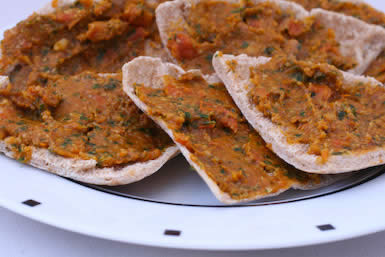
 My Italian is pretty basic, although I studied it a bit when I was going to be traveling to Italy, and I'm learning ingredient names from my great friend Ilva's blog. But I know enough Italian to guess that Festa al Fresco means something like a feast of fresh ingredients. So when I heard Ivonne of Creampuffs in Venice and Lis of La Mia Cucina were hosting La Festa al Fresco, I was excited about participating in the biggest virtual food bloggers picnic ever.
Wednesday, March 11, 2015
Autumn Harvest Soup with Butternut Squash Kale and Farro or Brown Rice
This delicious Autumn Harvest Soup with butternut squash and kale has some of my favorite fall and winter ingredients.

Click to continue reading
Read more »
(Autumn Harvest Soup was updated with better photos in November 2014.)
Sometimes recipes that just come together out of whatever's on hand turn out to be some of my favorites, and this Autumn Harvest Soup with Butternut Squash, Kale, and Farro (or Brown Rice) is one I came up with when I had butternut squash and kale and I'd been craving Farro, an ingredient I've loved ever since I tried it in Farro with Mushrooms. The butternut, kale, and farro combination here turned out to be wonderful, but if you wanted a gluten-free version you could make this with brown rice, which would also be very tasty.
Click to continue reading
Sunday, March 8, 2015
Daily injection which is better than dieting or exercise on NHS soon

A treatment of injections that can help people lose a stone more than they normally would by dieting or exercising more has been approved by health watchdogs.
Liraglutide, which has been described by doctors as life-changing, could be available on prescription in months.
Slimmers typically lose almost a stone more than they would by simply watching how many calories they consume and doing more exercise.
Trials showed that some severely obese patients lost so much weight they were able to abandon their wheelchairs and walk normally for the first time in years.
Liraglutide also lowers blood pressure, raises good cholesterol and prevents diabetes.
According to its makers, Novo Nordisk of Denmark, the drug even produces a feel-good factor, making dieting a pleasure.
But some experts have already warned it does not provide a long-term solution to the growing problem of obesity in Britain.
Novo Nordisk will apply for it to be prescribed on the NHS after Friday’s ruling by the European drugs regulator that it is safe and effective.
There are fears however that Nice – Britain’s drugs rationing body – will judge it too expensive for routine use on the NHS.
Liraglutide costs from £2.25 a day, which is roughly double the price of Orlistat, the only other prescription diet drug.
Patients inject the drug into their stomach before breakfast every day. It works by suppressing appetite.
Liraglutide, which will be given the brand name Saxenda, is already used at a lower dose to treat diabetes. It is based on a hormone found in the gut and sends signals to the brain that trick it into feeling full.
As a result, people eat 10 per cent less food than normal.
Trials of Liraglutide found that men and women who injected themselves daily lost an average of 19lb in 12 months. This is almost a stone more than they would lose by being on a diet and increasing the amount they exercise.
Furthermore one third or those who took part in the trials shed 23lb – more than a stone and a half. For a 14 stone woman that kind of weight loss would usually mean dropping two dress sizes.
The drug which, like insulin, comes in an injectable pen, also has such a significant effect on blood pressure that patients can dispense with the drugs they use to keep it under control.
Like Orlistat, its prescription is likely to be limited to those who are obese or who are overweight and have another health problem such as high blood pressure.
Mike Lean, professor of human nutrition at Glasgow University, told the Mail: "Liraglutide is absolutely life-changing for many of our most difficult-to-manage patients. Most do well, and some amazingly well. And it is extraordinarily safe, at least over the two to three years for which we have good evidence, with no signals to suggest serious side-effects.
"The only real downside is that it is jolly expensive."
Professor Jason Halford, former president of the UK Association for the Study of Obesity, said: "It is potentially very exciting. The real benefit of it is that it is targeting appetite. It strengthens the effects of satiety."
Obesity levels have doubled over the past two decades, making the UK the second-fattest nation in Europe.
Exptensive research has found that being obese can lessen persons lifespan by as much as nine years and raise the risk of a host of health problems including diabetes, heart disease, stroke and cancer.
Tests have shown that dieters taking liraglutide lose almost twice as much weight as those on Orlistat.
However, Professor Iain Broom, director of the Centre for Obesity Research at Robert Gordon University in Aberdeen, said that drugs were never going to provide a long term answer to obesity.
He said: "Until society changes and the Government’s relationship with the food industry changes and the food industry itself changes, we are not going to get anywhere very fast."
The European Commission is expected to approve the drug’s licence within the next two months, paving the way for it to go on sale. Novo Nordisk says it could be launched in Europe, including the UK, this year.
By Patrick Sawer
Source: http://www.telegraph.co.uk/lifestyle/wellbeing/dietandfitness/11367203/Daily-injection-which-is-better-than-dieting-or-exercise-on-NHS-soon.html
Saturday, March 7, 2015
Sucralose Hazardous or Innocent A Review of the Review Part I Glucose Insulin GLP1 Sucralose Diabetes
 |
| Sweet, low and unhealthy? Is sucralose as bad as a recent review would suggest? |
First things first: What are we talking about?
As the press release informs us, an "extensive review published by Taylor & Francis"... stop, so here is our first hint. The authors of the press release are people from Taylor & Francis and have a vested interest in writing it in a way that will have people share the text and their name on the Internet (that worked pretty well, as you can see - even I am talking about it ;-)
This is part I of a multi-part series:

Sucralose, insulin, glucose, GLP-1

Appetite, Obesity & Gut Health

Cancer, Drug & Hormone Interact.
I know that Mark Sisson likes to says this, but this website is not written by a machine, but by a man who has the same "short" 24h days you have... basically, what I am trying to say is that I had to split this review of the review into a "trilogy" - and be honest, you wouldnt want an article thrice as long as this one, would you?
Based on hundreds of [...] publications?
While it is true that the review has 476 references, not all of them deal with sucralose and only few of them provide data that would by any means be relevant to the most important question of all: "Can sucralose consumption harm us". The statement "based on hundreds of [...] publications" is thus misleading, because when its used in conjunction with the word "review" people will interpret it as the number of relevant papers - or, even worse, of studies the data of which has been used in a systematic review. The paper at hand is yet everything but a systematic review - its a narrative one.
Next on the list of our "review with your critical thinking cap on the head" list are the following claims about the health / environmental effects of sucralose:
- Please note: I will address all the issues within this trilogy, but for today I will focus on the one with the asterisk (*). As you can see from the headlines in my preliminary outline above, the rest of the issues are going to follow, asap.alterations in insulin, blood glucose, and glucagon-like peptide 1 (GLP-1) levels,The best thing you can do if you want to make sure youre not going to miss a single article is to register for the SuppVersity Newsletter at the bottom of the page or - even better - like the SuppVersity Facebook Page and youll always be in the know.
- metabolism of sucralose in the gastrointestinal tract to metabolites whose identity and safety profile are unknown,
- induction of cyctochrome P450 and P-glycoprotein in the gastrointestinal tract to levels that may limit the bioavailability of therapeutic drugs,
- reduction in the number and balance of beneficial bacteria in the gastrointestinal tract,
- histopathological findings in gastrointestinal tract including lymphocytic infiltrates into epithelium, epithelial scarring, mild depletion of goblet cells and glandular disorganization in the,
- decomposition and generation of chloropropanols (a potentially toxic class of compounds) during baking, and
- mutagenic alterations using several types of biological assays
Claim I: Sucralose messes w/ blood glucose management
I have to admit I was very curious to see the evidence on which Schiffman & Rother base this claim and was pretty disappointed, when I saw an extensive list of rodent and cell model studies, like those by Jang et al. and Margolskee et al., in which human NCI-H716 cells (Jang. 2007) and mouse enteroendocrine cells (GLUTag; Margolskee. 2007) were used to support the claim that sucralose would lead to an increase in GLP-1 - which is, by the way you usually wont hear as an argument against artificial sweeter use ... anyways, we are going to see why later, for now it should suffice to say that this intrigued me.
 |
| In view of the physiological role of GLP-1 its by no means clear whether the mentioned increase is actually something to be afraid of (see "Eat More, Burn More and Lose Fat Like on Crack with GLP-1!? Roux-en-y Bypass Study Sheds a Whole New Light on Satiety(Hormone)-Induced Weight Loss" | learn more) |
The thing wed have to fear is thus not the release of GLP-1 (for a large majority of the increasingly overweight population this could actually be beneficial), but a "dysregulation" GLP-1, GIP, C-peptide, insulin, glucose, and so on and so forth....
I dont say that its impossible that this is going to happen, but by no we have no convincing evidence that it will and in view of the fact that a scarcity of glucose is not exactly something to be afraid of in this day and age, an increase in GLP-1 could actually be an advantage for the majority of SAD-dieters. Unfortunately, the real-world (=non-petri dish) evidence from a 2009 study by Ma et al. tells us that this is not going to happen in humans.
 |
| Figure 1: GLP 1 (left) + insulin (right) response in healthy individuals to sucrose, saline (control) or 80mg and 800mg sucralose (theoretically this would be as sweet as 48g and 480g of pure sugar; Ma. 2009). |
Granted: Even the authors cite evidence against the GLP-1 hyothesis
I know, not everyone is willing to briefly type "GLP1 subjects sucralose" into a search engine, wait for the results to pop up and follow the link to the previously cited study by Ma et al. I understand that, but if that was you, you would actually just have to scroll down to the bottom of sensationalist press release, I cited on Facebook and click on the link (or enter the doi) to the (free) full-text, to find the following line on page 402:
"Oral consumption of sucralose without co-administration of glucose (Brown et al.,In other words, contrary to the author(s) of the press release, Schiffman and Rother are well aware that their evidence is far from being conclusive. What I am not so certain about, though, is whether they are also aware that their reference to a study by Brown et al. from 2009, where the coningestion of sucralose with acesulfame-K in 240 ml of caffeine-free diet soda (Diet Rite cola) produced an increase in the GLP-1, but not insulin or glucose (see figure 2), could actually be interpreted as a highly beneficial result.
2011) produced no significant effect on blood glucose levels. Sucralose delivered by intraduodenal infusion in combination with glucose also exerted no marked effect on blood glucose or plasma GLP-1 (Ma et al., 2010)."
 |
| Figure 2: Glucose, insulin and GLP1 response to oral glucose tolerance test conducted 10min after the ingestion of 240 ml of caffeine-free diet soda (Diet Rite cola; boxes) or carbonated water (circles; Brown. 2009) |
reduced the fasting and 8h post-meal free fatty acid levels of type II diabetics by -25% and 30%,The WM-HDP ↔ GLP-1 ↔ fatty oxidation connection | reread "Waxy Maize Reloaded" read more - improved the 8h blood glucose levels,
- decreased the HbA1c value from 9.2% to 7.9%,
- normalized the levels of cell-toxic fructosamine,
- slowed down gastric emptying
- decreased their ravenous appetite,
- improved insulin sensitivity and β-cell function, and
- induced a -3% reduction in total body fat.

 |
| "Science Round-Up Seconds: The Pro-Insulinogenic Effect of Artificial Sweeteners + Mechanisms & Consequences" | more |
As far as centrally mediated effects are concerned, the upcoming installments of what began as a comment and became a series of articles on sucralose may provide at least some insights into potential long(er) term effects on blood glucose management. Derangements that occur in response to changes in the gut microbiome, endocrine system or toxic effects of sucralose or its byproducts would after all only become visible after weeks or months of chronic (high dose?) ingestion of this globally approved artificial sweetener.
- Brown, R. J., Walter, M., & Rother, K. I. (2009). Ingestion of diet soda before a glucose load augments glucagon-like peptide-1 secretion. Diabetes Care, 32(12), 2184-2186.
- Ceriello, A., Novials, A., Ortega, E., Canivell, S., La Sala, L., Pujadas, G., ... & Genovese, S. (2013). Vitamin C Further Improves the Protective Effect of Glucagon-Like Peptide-1 on Acute Hypoglycemia-Induced Oxidative Stress, Inflammation, and Endothelial Dysfunction in Type 1 Diabetes. Diabetes care, 36(12), 4104-4108.
- Fujita, Y., Wideman, R. D., Speck, M., Asadi, A., King, D. S., Webber, T. D., ... & Kieffer, T. J. (2009). Incretin release from gut is acutely enhanced by sugar but not by sweeteners in vivo. American Journal of Physiology-Endocrinology and Metabolism, 296(3), E473-E479.
- Jang, H. J., Kokrashvili, Z., Theodorakis, M. J., Carlson, O. D., Kim, B. J., Zhou, J., ... & Egan, J. M. (2007). Gut-expressed gustducin and taste receptors regulate secretion of glucagon-like peptide-1. Proceedings of the National Academy of Sciences, 104(38), 15069-15074.
- Ma, J., Bellon, M., Wishart, J. M., Young, R., Blackshaw, L. A., Jones, K. L., ... & Rayner, C. K. (2009). Effect of the artificial sweetener, sucralose, on gastric emptying and incretin hormone release in healthy subjects. American Journal of Physiology-Gastrointestinal and Liver Physiology, 296(4), G735-G739.
- Margolskee, R. F., Dyer, J., Kokrashvili, Z., Salmon, K. S., Ilegems, E., Daly, K., ... & Shirazi-Beechey, S. P. (2007). T1R3 and gustducin in gut sense sugars to regulate expression of Na+-glucose cotransporter 1. Proceedings of the National Academy of Sciences, 104(38), 15075-15080.
- Panjwani, N., Mulvihill, E. E., Longuet, C., Yusta, B., Campbell, J. E., Brown, T. J., ... & Drucker, D. J. (2013). GLP-1 receptor activation indirectly reduces hepatic lipid accumulation but does not attenuate development of atherosclerosis in diabetic male ApoE−/− mice. Endocrinology, 154(1), 127-139.
- Pettus, J., Hirsch, I., & Edelman, S. (2013). GLP-1 Agonists in Type 1 Diabetes. Clinical Immunology.
- Ren, X., Zhou, L., Terwilliger, R., Newton, S. S., & De Araujo, I. E. (2009). Sweet taste signaling functions as a hypothalamic glucose sensor. Frontiers in integrative neuroscience, 3.
- Schiffman, S. S., & Rother, K. I. (2013). Sucralose, A Synthetic Organochlorine Sweetener: Overview Of Biological Issues. Journal of Toxicology and Environmental Health, Part B, 16(7), 399-451.
- Schwartz, S., & DeFronzo, R. A. (2013). Is Incretin-Based Therapy Ready for the Care of Hospitalized Patients With Type 2 Diabetes? The time has come for GLP-1 receptor agonists!. Diabetes care, 36(7), 2107-2111.
Subscribe to:
Posts (Atom)